Wednesday, December 12, 2007

"Ghost Dog: The Way of the Samurai" (1999) - Movie Review

Apart from various codes and cultural significance in Jim Jarmusch’s “Ghost Dog: The Way of the Samurai”, it runs a parody of assassins movie and be one too. This adds the already supplied humour by the Mafia character, Sonny Valerio (Cliff Gorman). As always with his love for his way of movie making, Jarmusch ropes in Forest Whitaker as Ghost Dog, a clean cut hit man following rigorously the code of Samurai.

A professional assassin or a cold hearted killer in films should (a) have an animal or plant to be loved upon and even confide sometimes for no other reason (b) a little girl who he finds irritating but eventually likes (c) does not talk at all and when he does, it is less than or equal to two words like “Good Bye”. Ghost Dog does every one of those but still stands apart breaking that immediately. He nurtures pigeons and more than the love for it, uses them as messengers which keeps him in the hide. He does find a little girl Pearline (Camille Winbush) who is not irritating but extremely well read. He does not talk much but converses when necessary. He does it quite generously and each with precise value of wisdom and humility. Out of this Jarmusch creates a unique killer from the used up characters in various other films.

Many references can be linked (obviously) to Japanese ancient teachings and the films based upon it. The book of “Rashomon and Other Stories” wanders in the possession of many characters finding it way back to the source of it. Particular sections of philosophical wisdoms from the book “Hagakure” having comprised commentaries of 16th century Samurai Yamamoto Tsunetomo are embedded in between scenes. It is noble and runs the theme the picture is built upon. As with any Jarmusch’s film, plot is a layer of hidden meaning and interpretations which can be read to complete its significance. Yet the film has its content which flows on for its artistic and comical sequences.

Ghost Dog as per the Bushidō code respects and serves his one time saviour Louie (John Tormey) who belongs to the Mafia family of Ray Vargo (Henry Silva). As the orders given to Louie in turn to Ghost Dog, the hit is on Handsome Frank (Richard Portnow), Vargo’s own member but pays the price of being intimate with Vargo’s daughter Louise (Tricia Vessey). Ghost Dog makes the kill but the daughter is not supposed to be there. More than their cover up, the Mafia needs to follow their rule book, vendetta for their lost man. Comedy of rules that they order the hit but want to tally it in their killing account to take off Ghost Dog, the killer. The war begins and Ghost Dog is caught up in between performing his duties to his “retainer” Louie and also paving way to make him perform the code of Mafia.

While it has the plot, it is about the making, the chemistries, the dialogues and the mannerisms which are the traits of an individual film maker. The love of art from him that Jarmusch sometimes makes movie with no concern for any one but his idea of representation. And that is not a bad thing but a characteristic of a true artist. And when you see Mafia, we get doubts of a director falling for the Hollywood luring of type cast movies, but he invents a new side of this aging trend. His ears for the music to pick out the Wu-Tang Clan’s RZA are the icing for a film which blends Eastern Culture into African-American culture.

It is a contrast of both the traits, Samurai and Mafia. Both are loyal killers. The people differ but end of day they are cold blood killers. But Samurai seems to be pure and immaculate. The dedication he exhibits migrates beyond anything at all. In a world of even a good deed involving a selfish closure, his strict ethical adherence to the code is selfless as the word can only be used for him alone.

The film cannot be appreciated by all. I too was distracted by the banal scenes sometimes but the slice of characters the film gives at various instances cannot be replicated or reenacted by any other creator in other movies. The Mafia is getting old and outdated. They are in financial burdens and in the verge of falling flat in these modern times (I strongly suggest to look into “Out takes” in DVD which has the “Bankruptcy” sequence). But the people are not able to bend accordingly. And that is given in one of the best funny moments possible in even if a spoof is created. Cliff Gorman’s Sonny is irresistibly funny. Call me ridiculous but an old Italian Mafia King rapping to the songs of Flavor Flav from Public Enemy is a priceless moment.

It is a parallel analogy of two codes. One ancient and one formed later in the current trend. It is how both manage the test of times. The ancient one even though old school has its words written in the history transforming into life lessons for any one and does not need to be a Samurai. Strangely enough Mafia’s code encompasses the people in it and it is more of survival technique. It is self centered into one family and honour associated with it. One as a physical form survives in the film and demise marks the other but we know which stands the test of times once it is over.

Tuesday, December 11, 2007

"Nobody Knows" (Language - Japanese) (2004) - Movie Review

When the film itself draws unimaginable pain and sympathy, it is far more shocking and intolerable to think there was an actual event, the film origins upon. In late 1980’s Japan, a mother abandoned her children to live with her new love and I will let you to see the film and then read about it. It is one of the most tragic films I have ever seen and the one which affected a lot on emotional level. While I certainly do not appreciate much of film which does not carry some sort of experience to be grasped upon, I feel this is a story to be told and to be heard by every one.

Akira (Yûya Yagira) is an automatic responsible 12 year old brother you would have seen in among the road side homeless children. Here he takes care of his siblings Kyoko (Ayu Kitauru), Shigeru (Hiei Kimura) and the young Yuki (Momoko Shimizu). They arrive with their mother Keiko (You) in to new apartment in Tokyo. Keiko introduces only him to the landlord and we do not even see the rest of the kids. Then once they move all their things, the suitcases open and kids come out laughing and giggling. The scene is cute, because we forget the gravity of how they transported over by their faces full of innocence and happiness. We see the immediate big brother caring Akira shows and his second in command Kyoto understanding him.

Keiko appears to be loved by the kids including the well aware Akira. It is an unexplained biological and spiritual explanation only the unknown can describe as this unconditional love between a kid and its parents. Both know nothing about each other and still the trust, belief and the affection takes enormous chronic betrayal to break that bond. Keiko does it without any effort and frowns at Akira when he confronts her of being selfish. Keiko while with the kids does not abuse them rather appear as honestly loving them. But we come to know that each kid has different father. These are not the responsibility she hoped for and more of mistakes. She does not reveal any of them except Akira so that they do not need to be sent to school.

Akira with the money Keiko left behaves as if nothing happened. Surprisingly the other kids are not surprised either. It is a usual happening for them. Only this time, her return is questionable. Akira knows it and even when he finds out where Keiko is working, he does not want to tell his siblings. He does not want one another disappointment. He wants to be done with these cheatings once and for all. Soon, the money evaporates and the bills pile up. In the midst of this, Akira in the desire of wanting to enjoy the boyhood life gets the friendship of rich kids who just use him as an easy prey for getting games and playing indefinitely at his house. The house maintained by him goes filthy and unmanaged.

If the film would have been melodramatic which for every reason it could have been, I could have blamed it for being so cheap and exploitive, then get on with it. Director Hirokazu Koreeda unmercifully gives the brutal natural feel which just gets too much as the film goes. It is not easy to digest a film like this and when it comes to review, it gets even tougher. When things happen with some one not directly to blame and innocence is shredded into pieces, it is heart breaking.

How did they manage to be unnoticed and unsuspicious for such a period of time? In this busy world with life confined within four walls, everything is unnoticeable. I live in an apartment complex and still do not know who lives above me. Where does the line lies in between respecting privacy and watching out for each other? I exactly do not know but that would have helped a lot for those children.

Koreeda uses props of natural progression to depict time. The long hair of the kids, the plants seeded by them in the ready made noodles cup (which is how their food necessity gets satisfied) growing and creeping on the rails, stains on the floor getting thicker and older are some of those subtle techniques employed. The dialogues are terse and astonishingly the kid’s unemotional sullen faces exactly bring out what would have been the scenario in real life. The score by the guitarist duo Gontiti provides the melancholic cuteness of these unguided angels. It would have been a monumental task to make these small actors express themselves. Yûya Yagira and his sibling actors’ chemistry is natural and just knocks us out on how grasping and talented are they.

I did not watch “Requiem for a Dream” for a long time due to its nature of content and the depressing tone it ends on. I managed to watch it and felt miserable. Here is “Nobody Knows” where we are tied to our materialistic comfort to watch a family of four kids dismantle slowly and in a hurting reality of life. Destitute and despair surround these kids who got conditioned to these desolation and hence it depresses even more when it keeps on getting worse.

Monday, December 10, 2007

"Kontroll" (Language - Hungarian) (2003) - Movie Review

Nimród Antal’s debut “Kontroll” happens in the Budapest Metro subway. It is supposed to be interpreting lot of things and for me it meant that it is a confused story with assumptions and presumptions. It is boring, dragging, frustrating and some times irritating ride (forgive me) you could ever get. If this is how the Metro system’s ticket inspectors are treated with people, then that should mean that the city is the worst place. Every one they meet gives them trouble and torture.

There are groups separated in the ticket inspecting circle. Bulcsú (Sándor Csányi) and his team are the losers challenged by the Gonzó’s (Balázs Mihályfi) team. And we thought every one leaves the high school fight behind and grew up. Ok, I can understand it is a boring work to check tickets and to liven up they do something like this but they are just a bully and nothing philosophical about it. Now Gonzó challenges Bulcsú in a “railing” contest which is gives a good thrilling moment. And you will also know when it will be used again by the hero to out do some one. I cannot believe they pull off the oldest and cheapest trick from the book.

When these things are happening, it is come to notice that people are getting killed jumping in front of the train. Initially suspected as suicides, we are shown a hooded strange man pushes people off guard from the platform. In fact in one scene when Bulcsú chases someone, he witnesses the act and the killer passes by shouldering Bulcsú. Is Bulcsú imagining all these? That’s an obvious pay off but nope. Is he the killer? That’s another obvious guess and nope. So they decide to stump us with everything and honestly it means nothing. It is fine that films like these leave without explaining anything but the journey (forgive me again!) should be interesting.

Who is Bulcsú? What is his hidden past? Why is he staying 24/7 in the station? What is he hiding from? We get to know zilch about it. All we know his colleagues are crazy enough as that of the people they encounter. The conversation goes no where and we wonder what the director is trying to say. It beats us up with crazy talks and weird visuals with super sleek look and void in our minds.

It needs to be appreciated that the feel of the movie is creepy but brisk and dull of an early morning as expected. Antal has the eye for the visuals, colours and the ambience to be generated for the film. He is obsessed with trance, hard rock, industrial and rock music which he lavishly uses for insane and ridiculous style scenes, as it is aimed. The film supposedly won acclaim in the art house circuit. I was able to interpret something but it did not come out automatically as the depiction goes. Since I felt wasting some time watching something over the screen, I forced myself to grasp some meaning out of it. And it also matched some of the metaphysical meaning Wiki suggested but it does not suit the character of Bulcsú. He is calm, composed and has these weary eyes of hiding something. He is stressed and irritated. I mean who will not when you meet people who can get on your nerves to push the wrong buttons. The film never takes off as it started. It had its slapping moments but it kept repeating evaporating concepts of confusion and non-descriptive images.

I crave for films which has submerged meanings. I long for the movies with cryptic messages and just play with the images. The simple movements, the jarring music and colourful club lights are all my cup of tea. And “Kontroll” has those and at time does well too. The thing is it should lead somewhere with a higher purpose in its agenda. The whole movie can be comprised of thirty minutes of material. I never understood Bulcsú’s attraction with the bear costumed Sofie (Eszter Balla) and his dinner conversation with her father Béla (Lajos Kovács). The only comic thing about the movie is that it is supposed to be a dark comedy too, irony I guess. Antal sure did impress lot of people with his visuals which of course is terrific. He got his next Hollywood movie “Vacancy”. I got nothing.

Saturday, December 08, 2007

"Rescue Dawn" (2006) - Movie Review

“Rescue Dawn” inspires from the true story of Dieter Dengler (Christian Bale), whose plane was shot down in Vietnam, got captured and then organized an escape from the prison camp with other POWs. We have seen the unrealistic Hollywood escape movies and the more touching real ones too. It falls in the latter category I described and yet I feel it is not something to be categorized. Director Werner Herzog gives more than an escape story. It is a survival ordeal of a single man eternally optimistic in every thing and still practical enough to eye out the details for a neat plan to be alive.

The worst kind of prison is to get stuck in jungle with no food whatsoever. The first day when Dieter arrives at the prison camp, he hears it from Duane Martin (Steve Zahn). “Jungle is the real prison” he says and we will soon realize it. It is beauty to watch the nature as a pleasurable sight seeing experience and when we touch in deep, it is not a civilization and the assumed necessities need to be fought. We humans underestimate and create an ego so easily over Mother Nature. And out here we see it painfully and with resources abundant yet no way to reach it perfectly without any doubt.

The film starts off with Dieter about to embark his first mission. You should hear his aspiration of becoming a pilot. It is frightening, funny and inspirational. Dieter a born German landed on US to fulfill his dream to fly. His view towards war is sure seems to be neutral but his zeal to fly has brought him to the death zone. This is not a war movie. This is a look into a human being human in an inhuman condition. To retain the sense of humanity becomes the prime objective of survival. In the middle of it, there are conflicts, fights and a friendship of pure love.

When a new pupil comes in a prison camp, it forms as a small group of civilization. There they form their group, the leaders, entertainment etc. When Dieter comes in, he takes no time to mingle in. His high energy to keep his head above water gives some form of hope to these prisoners. They have built a false hope for more than two years having the idea of being released and the concept of war negligent. Eugene (Jeremy Davies) is one of those who do not want to believe in the truth Dieter says. Eugene has lost his touch with sanity being in the hole for a long time. So does rest of the others but Eugene firmly believes that there is going to be a free release that he is even ready to foil the plans of Dieter’s. It does not develop into the animosity we have seen in movies before. Even after the scary talk, they all come together to wish Dieter his birthday and offer him a concoction of weird plants or creatures.

The film creates this miserable situational humour through editing. It is out of their misery but even they would have laughed in real events and that makes it humorous in this intolerable ordeal. Bale and Zahn carry the friendship of Dengler and Martin to something which makes it every bit of true and real emotion to it. And the way both weave in and compliment each other makes their jungle struggle one of the memorable tragic events.

It has been laboriously shot. You know they are cutting a fresh thick bush with machete which is totally untouched, hence becoming totally unknown and dangerous. It is dangerous for the venomous creatures they might mess around. It can be easily observed of how much the technical crew has to work on their way into the fierce river, muddy soggy ambience and morale so low to be depicted over the screen. And with all the actors portraying prisoners losing their weight ridiculously, it droops on to us on how tired and helpless each of them is.

Dieter Dengler is the only other prisoner who made out alive escaping from the Prison Camp. Werner Herzog made a documentary before this titled “Little Dieter Needs to Fly” which is going to be in my film queue. This is a film which tells us why we are so fragile and also so hopeful. It warns us on how the mind can never really be sane when the situation around you makes it tougher and harder to stay in touch with reality. Dieter did have luck favour him which it did not for rest of his fellow prisoners. But it is the spirit, survival, optimism and the hope which kept him happy in those dreadful days and alive forever.

"The Golden Compass" (2007) - Movie Review

“The Golden Compass” puts firm foot for its foundation of franchises to produce the further sequels of the three novels of Phillip Pullman. This adapting the first one, “Northern Lights” (or “The Golden Compass” in US), carefully stays within its realm of starting the things than going deep inside it. The downright fantasy genre is not a particular choice of my taste but I need to accept that like summer block buster action or any other, it has its territory to excel. I like imagination blending with realism as in with “Bridge to Terabithia” or “Pan’s Labyrinth”. With that thought, “The Golden Compass” is fairly interesting and keeps you occupied.

It was good to see a kid, who immediately learns and not alone is at the mercy of its saviour. Lyra (Dakota Blue Richards) brought up by his Uncle Lord Asriel (Daniel Craig), is smart, courageous and also does not overflow her childish face far too long. Everything happens in a parallel universe and a gentle facet but a characteristic of an authoritarian government called the Magisterium. Asriel’s belief over traveling to other universe and research over it threatens the Magisterium and mainly their main player, Coulter (Nicole Kidman). It is not an explanation of the problems but the other aspects of it become the mission for Lyra.

The idea of having a daemon representing the soul and spirit of any individual is in the right word “cool”. It is not a pet but it can be. But having some one as trustful as you are and as free will as you are, yet another entity is lusciously inventive. Of course it is a part of you and whatever we think over our head, the supposedly “good” and “evil” side of ours having sword fights over decision, and to bring it outside as a physical being has both the uber factor and also the philosophical dimension. Is not it so appropriate for Craig to have a cheetah (or a hybrid of cheetah and tiger or whatever, some cat) as his daemon? But you need a violent monkey/chimp for Nicole Kidman to make her fit the villain.

The part which really knocked me out is the showdown fight between Lyra’s monstrous bear friend Iyorek Byrnison (Ian McKellen’s voice) and his nemesis Ragnar (Ian McShane’s voice) is simply punching. The expectation is already known but the execution (literally) is a killer visual and timing. That marks the high point of the film apart from which it is a very usual journey for its genre. Director Chris Weitz with his brother Paul has come out previously with “American Pie” (he was uncredited though) to “About a Boy” and now this, a solo venture. And something radically different for the genre he has been working on. It is something surprising how one can adapt well enough to the genre he is shifting upon.

We do not very well know about Lyra as that I believe will form the sequels to explore on its way to the further story. Similarly there are other characters which show signs of development in future. This had an effect on me having a void when they speak. The script hence makes it a point to talk over rescue details and the goals to attain it rather than pondering the back ground. It desperately wants to form a basis but also an adventure/action journey to make it a movie of its own. I would not praise it but I appreciate for keeping me looking at the screen with things happening.

And now with the controversies over the “religious” aspects of the book and hence its affiliation over the film, this movie does not have any representation or reference to any religion whatsoever. It just shows a government for reasons not concretely known wants to stop the universe travel. But it is mentioned in Wiki that the three books have some content over it. The fear of the people objecting the film is that the encouragement kids might get to read the book through the film and become an “atheist”. I do not understand why any one might want to object a film based on some child who would “think” on his/her own and opt a choice (at an age of knowing things for what it is). I believe that’s the role of every parent and hence would talk about it objectively. But is it not the representation of us, the human beings as the thinkers? I have all respect for all the religion and anything which is going to hurt the sentimentality need to be considered but one cannot force some one to think or limit the conscience. Why does it mean so much if some one becomes an atheist or theist or whatever they want to be? If some one does some terrible thing blaming/basing over their beliefs, it is still the person who is responsible for its consequences than the belief. By objecting the film, they exactly prove the author’s depiction of the Magesterium.

Friday, December 07, 2007

"A Man Apart" (2003) - Movie Review

Probably every one of the 80s flick’s cold sad one liners have been taken to use in “A Man Apart”. This film has no confidence in itself that it needs the hero Sean (Vin Diesel) to grow a beard to show his grievance. I remember gimmick like this been employed in the old 80s Tamil film and the entire summer action Hollywood block buster. A vengeance tale is been attempted to be told and approached as a man’s inner turmoil, a suspense and a stylish violent drama. It does not work in any of those.

Danny Parker/Tom Van Allen in “The Salton Sea” and Leonard in “Memento” deal with their own struggle and grief in complex entertaining ways but still flags the rage in them to go about finding the killers of their respective wives. Today an article in rediff.com said that men are more prone to die once their loved ones depart from them. So we can empathize a lot with Sean (and it is the article and not the movie creates this). But Sean deals with his grief as expected with aggression and insane behaviour. He puts every one in jeopardy inclusive of his dear friend, Demetrius (Larenz Tate). Sean is a tough man to talk about feelings, understandable and an action film to even slightly analyze about it is not expected or may be even might pose awkward. The film wobbles with the idea of to deal or not to deal with his issues. It tries to skim the surface but never has the daunting courage to see inside this devastated man.

So does it mean they take it a notch up with the violence and give a cold hearted action film? No! They give out random gun shots and gruesome murder scenes which have no connection with the ghost drug lord named Diablo they are hunting. Sean busts his seven year work on the big drug lord Memo Lucero (Geno Silva) and the scenes depicting the next big head Diablo as they say, an invisible psycho terror takes over the kingdom of drug cartel left by Memo. Along with it for reasons later said an attack over Sean’s residence kills his wife Stacey (Jacqueline Obradors). So as soon as he gets up from his hospital and visiting his wife’s grave, he directly goes to the one and only man who would want him killed, Memo. But Alas! He is not involved as his “If I want you dead, you would be” dumb dialogue clears his name. If that dialogue is not sufficient for the inability of the writers to come up with an interesting conversation, you need to watch this. Sean visits Memo again and now Memo wants to talk. Memo is sitting in a visiting room with “modern age” spa environment (only in Hollywood jail facility) and he starts talking not looking at Sean and starts, “Me, my brother and sister used to sleep in one room”. It cracked me and was laughing hilariously. Now that is a scene directly needs to be included in the “Hot Shots” or “The Naked Gun” franchise.

F. Gary Gray has good eyes for some visuals and also likes heavy metal at inappropriate times. There are random characters for no particular reason or their fancy element is not sleek either. Hollywood Jack (Timothy Olyphant) is one of many wasteful characters just used as a deviation for the pay off while the audience had by that time worked out the permutation and combination of who tricked Sean and Jack was the first one to be out from that list.

It is films like this which reminds how bad Hollywood can get and how slick they do it too. I can only imagine how Vin Diesel told some of the dialogues without flinching. He is a good actor for a role like this but even he displays offhand work. We can almost see his disinterest and disbelief in this character.

There is significant evidence that they were not able to show how much Sean misses Stacey. When the film carries on with all lovely happenings, happy get together and sharing “I Love You”, the result is certain. Some one needs to die and especially the actress who is less known. To make us sympathize for Sean depends on the casual love and bond he shares with Stacey with good emotional un-cheesy scenes. They act happy. They act. Period. This puts them to further show a scene of melancholy back ground with Sean thinking their good times. Another point of no confidence over the script.

When the film started off with a story line known, I was expecting an action film. Then it turned down in detailing the drug traffic statistics and hence thought it is going to be about that. Suddenly it attempts to shift into drama mode of Sean’s sadness and then a vain twisted change into a cold violent thriller. At this point, I was confused on what to think. And when the talking started, it became a parody of itself. You cannot enjoy it even as a funny movie because you have seen everything in “Hot Shots” which by the way is more action/drama genre than this. And damn it was funny too.

Thursday, December 06, 2007

"Mephisto" (Language - English / Hungarian / German ) (1981) - Movie Review

Hendrik Hofgen (Klaus Maria Brandauer) loves to be noted and appreciated. Why not because he not alone loves acting but trades his soul for survival, fame and the presence itself. While it won the 1981 Acadmy Award for Best Foreign Language Film, it did not manage to win me. The story is the life journey of Hendrik Hofgen, a born actor for theatre is obsessed with his talent and himself, suicides his conscience (if at all he has one), for furthering himself in the Nazi regime in Germany. It has more than two hours of him dancing, screaming, and talking within and of all wearing the mask of his cheerful devilishness of two faces happily. And we just cannot take it after a while not because of bad acting but the character itself is not much to resort upon for analysis. His sleaziness is too much for the screen. You can never find an angelic devil like that of Hofgen.

Brandauer gives the single most convincing and arduous performance in the film. Yet it is bland and dry content becomes placid and dull as expected. The hunger for success by Hofgen is a driving factor and his behaviour looks animated as he is as an actor. Director István Szabó intentions are well made. Definitely he made what he wanted to give. The 80s film has this effect of downer even in the brightest of lights. Szabó’s “Colonel Redl” carried similar tone but it had its character working up in a manner to have some interest. We sympathize and feel sorry for him. Here the character over rides conscience effortlessly and that is the essence of the film. Is there a need to study a character so shallow and consumed by his presence and talent? Yes, when the protagonist while not completely transcends into an opposite behaviour shows struggle of conscience. In “Mephisto” it happens late in the film and does solidify the moment of embarrassment and guilt but it evaporates instantly without any clue. Even otherwise, there should be a purpose in showing something chameleonic. Entertainment is one of those but the film is not your usual summer block buster thriller.

The problem I have with Hofgen is that the only reason he survived himself is the love over his image and the “art” of theatre wherein he advanced further by bonding with Nazi which is not something to be emphasized as a film. The metaphor of Hofgen being the German Legend Faust who made the deal with the devil is nice but even after so much of the subliminal preaching of his demoniac soul; it steeps down further and further with no salvage. More than the conscience, the film itself moves sluggishly and blare us with Hofgen’s face over the screen as much as possible. Even the brilliant acting of Brandauer cannot save this when two hours and twenty four minutes of him shouldering the script gets indifferent with itself.

One more monumental mistake which is blatant is the bad acting of several players. Since Brandauer takes almost all the screen time, even the slightest inexpressive face barks out significantly to note it. The very less attention they get makes them forgettable further weakening the story. There is one notable character apart from Hofgen which is the Prime Minister, who is an Army General (not able to find the correct actor name from IMDB). He is the only other who matches Brandauer. He has the menacing look but also a friendly talk. He is that character we have seen in many villains who cracks a joke in a monotone voice but every one awaits for him to laugh first to authenticate it.

Giving a self destructive person is fine to learn something from it. You do not show him through out the film and always on the screen. As any work, it needs a team. They had a team with very little roles to be played and with some bad performances too. I may not agree with Hofgen’s story to be told but if it could have been counter pointed by other strong positive performances, it would have gotten interesting and caught my attention too. But it circles around as its protagonist and ends up narcissistic as him. And a study of narcissist is not interesting.

Tuesday, December 04, 2007

"Election" (1999) - Movie Review

“Election” tells a story of wickedly aspiring girl, Tracy Flick (Reese Witherspoon), a true and good soul, Paul Metzeler (Chris Klein), his rebellious sister Tammy Metzeler (Jessica Campbell) and a mid aged teacher Jim McAllister (Mathew Broderick) consumed by his boring existence a.k.a mid life crisis, finds to hate Tracy is the only way out of it. It is a dry and dark satiric comedy over how one thing appears so important, casual and deadly to one another. It is funny as any high school movie you have ever seen and has a narrative style resembling “Little Children”. Of course both “Election” and that are adapted novels by the same author, Tom Perotta.

Director Alexander Payne has given dramatic comedy pieces after this which is “About Schmidt” and “Sideways”. In both those movies, the central character in each are running around in search of what to do after they lose their main hold over their life. Here it can be compared to Jim. Jim of course is no straight arrow. He is a teacher who as many teachers believes in what he does. He believes in nurturing every batch of young students into another step towards their goal with guidance and encouragement. Strangely he wants to stop one of her students, Tracy. Apart from his colleague Dave (Delaney Driscoll) getting kicked out for having an affair with Tracy, which of course he blames Dave too; it takes us some time to closely observe on his reasoning to despise her.

Tracy played spectacularly by Witherspoon jumps around and speaks like the “Energizer” Bunny. I am sure every one would have seen one like her in their high school days. Over attentive, over participative and over everything that you just need to push her face away from yours to get some air. She is omnipresent and omni-irritating. She has dreams, pretty high ones. She works hard and wants to be the top in everything. The problem is that she knows she works hard and demands good, no great things happening to her. She prays before the election to god, “I really must insist that you help me win the election tomorrow because I deserve it and Paul Metzler doesn't, as you well know.” This cracked me up on how lost she is in aiming high that she demands the all mighty and in fact tells what to think.

The movie name could have been “Omaha” or “Carver” as the film circles more on the place than the event. Election is the catalyst for these quirky characters to react. The dialogues are formulated such that they tell it how it supposed to be while the tone says of what they really feel. The film does haunt upon the “popularity” contest in high school but uses it wisely. And for once the popular guy is the nicest guy ever. I mean you cannot define a more genuine being than Paul. He does party and does have fun but he cares for every one and does not care for “Election”. It is his energy which counters all the negative energy by Tracy and Jim.

Jim is the study material. He is the adult and he is a mess. He thinks he is having a happy marriage but knows things are bland. The funny part about individual narration is that the characters care about what audience thinks, except Paul and his sister Tammy of course. Jim even though does not act as caffeinated as Tracy, has the natural chemistry of character as that of her. He sees a much of himself in her and he uses his friend Dave’s lost life as a cover up. Jim believes he deserves more than a routine sex of “fill” his wife Diane (Molly Hagan) with materials for reproduction. It is this moral flexibility he brings is funny and shocking at times.

Jim and Tracy are remorseless and guilt free go-getters. Both believe in the end and the means to get it hardly matters for both. They stoop down to each other’s low point and constantly battle to win something which Tammy truthfully and boldly speaks up in her speech. The film did not go in a happy ending as most would want to. While watching this dark entertainer, I thought about how I have consistently showed my discomfort over a good movie with no conscience or righteousness. Of course, it tells a story of twisted characters playing twisted games but it is shown with utter nakedness of how completely and unbelievably it is wicked that it makes us realize the rightness out of its wrongness. “Election” tells how we tell ourselves that we are right through Jim and Tracy while how certain people are just blindly naïve and ready to accept life as Paul even when they are wrong.

"Throne of Blood" (Language - Japanese) (1957) - Movie Review

Akira Kurosawa’s “Throne of Blood” (Japanese literal meaning as “Spider Web’s Castle) is considered one of the best film adaptations of Shakespeare’s “Macbeth” into Medieval Japan. I am not familiar with the readings or story of “Macbeth” (forgive my literary ignorance) and hence the view towards the film is purely for its content, which is how it should be. It might shock some, but the film lacked the development of characters which is something a corner stone in every Kurosawa’s movies I have watched till date.

There are parts of the movie which are technically versatile and exhibit what the director is famous for. With his regular favourite lead Toshirô Mifune as Taketori Washizu the courageous warrior, it tells the story of a loyal soldier into a treacherous and deceitful scum in this film. The venoms of doubts and betrayal are planted by his wife Asaji (Isuzu Yamada). As the introduction of Washizu with his trusted friend and subordinate Miki (Minoru Chiaki) in the dense forest comes in, we wonder how much of the director’s obsession goes with the nature, which he uses in all his films. And when the rain pours and lightning strikes, it just gets better. The encounter with a spirit/ghost they term as evil identifies them and mainly tells the cursed statements of its prophecy. This is the part which captured me immediately. The aftermath of their encounter when they sit down for resting, the tone and the timing truly brings the deepest thoughts in them. This is the characterization I always look for in Kurosawa’s movies and after this, it disappears.

Asaji’s background is not known. She is introduced directly as Washizu’s wife and right from the get go, she consistently spits doubts on him. There is no apparent reason for her to doubt both his Lord and his friend Miki. If it is to protect her husband and herself, it does not convince us in her wicked character every time. Even when Washizu is full of trust and goes on conscience reasoning, she shoots it down. Washizu is a man of rage and bravery but is he a fool too? Every one deep inside has the temptation of wealth and power. That is dealt in every day life and Washizu is not an every day person. He is pretty old and his traits are phenomenal before Asaji’s corrupting words. Asaji tackles perfectly but it seems so out of place and odd on the immediate acceptance of those by Washizu. We do not know much of back ground of Washizu, Miki and Asaji but that’s where the building of their personalities comes in. Sadly, it looks like an eventuality of the script rather than an event in the story.

The conviction is mainly missing in the characters. Mifune as usual with his mastery fierce look and powerful eyes is both frightening and menacing. Washizu’s conscience is flimsy for other unexplained reasons. Basing everything on the prophecy appears thin filmed as they look mature and reasonable. Their eagerness to be powerful is understandable but does it explain their blind belief too? Similarly Miki for unknown reasons doubts Noriyasu (Takashi Shimura) who Washizu and Asaji blame on killing the Lord. Of course he trusts Washizu but why does he shower arrows at the Prince who comes along with Noriyasu? He believes in the prophecy but the above action does not explain it at all.

The technical clarity is breathtaking. The moving cameras in the dense forest and the misty chaos with horse galloping in all directions are a tool of delusion and confusion. The silk dress of Asaji making the irritating sound and her way into the dark room to bring out the drugged Sake is another classic shot. The most impressive and dangerously shot sequence is the finale. The showering of arrows over Washizu and especially the deadly aim through his neck could have been a gory scene for those times. One cannot wonder how well it is done. It seems real arrows were used with professional archers to get a natural expression on Mifune’s face.

Even after all those technical expertise and acting of Mifune, “Throne of Blood” fails to make a mark. It is a short film for a story like this and lots of scenes were dedicated for movement than for dialogues or scenes to explain some characterization. At a time period less than this film both “Yojimbo” and “Sanjuro” accomplished its goal comfortably and brought a super hero character in it. It did not become a plain warrior fight or cleverness and improvising techniques of the samurai but some change in him as a person with strong scenes. Negative characters have the power and presence to make its mark to have a space in our heart, wickedly. Washizu sure does have the power and presence but that solely does not build up the film. Sanjuro is a negative character too but the transformation and realization of his bad means to an end is convincing. Washizu goes from being a loyal warrior into a wicked aspirer with few unconvincing words from his wife. That is not a trademark Kurosawa reasoning I know of.

Sunday, December 02, 2007

"Before the Devil Knows You're Dead" (2007) - Movie Review

“Before the Devil Knows You’re Dead” will be one of those few films which regenerate the effect of reading a book. The editing and screenplay have worked out so hard that it is believably rearranged which plays the theme of the film as it supposed to, a mess. How bad a person can put oneself into such a mess that there is no way out? After that small period of gap wherein you just wait to be hunted down, the characters foil up with something more to make it even more devilish, cornered and terribly stuck. Director Sidney Lumet has arranged this piece which is an exhibition of unforgivable sins and dreadful souls to succumb to the devil of unnecessary attention and money.

I have watched Lumet’s “Network”, “Serpico” and “Find Me Guilty”. In each of those there is his presence and his nuances in making us understand the characters. The fashion in his operation towards it is follows the methodical 80’s look. While all those three movies took place in that era, this film is in cell phone age. Yet Lumet decorates the 80’s look with a fashion of randomness and a screenplay giving a recursive feeling. The craft is to give a film which can be as satanic as possible that we the audience has no empathy or sympathy for any characters at all. Even some innocent person gets killed; but we have developed immunity of rest of the characters that we for that time period bring our dark brother in us to do a third shift.

Money is the prime agenda out here for brothers Andy (Phillip Seymour Hoffman) and mainly Hank (Ethan Hwake). Andy comes up with a plan he tells with so much ease and carelessness, that he convinces Hank to do it. But the film is not aimed at the anxiety to see the robbery. The second scene gives the act. The film circulates around its ripple nature of events. The events are not linear but in a fashion which resembles Tarantino. And when we think that, they circle it further more. The plan of course is not to confuse us but to make sense of certain behaviour of the characters come in light. There are scenes when Andy needs his focus but in the same scene, Hank might need more presence but it cannot be done perfectly in singular frame of scene. Hence some scenes are shown twice but the camera angles are different some times, the back ground score is different. This results in a product of multiple dimension of one scene. This technique helps to simulate the reading effect of crime novel. In novel though, we ourselves imagine the same content of page in different dimension when there is an unknotting of an event. Lumet just brought it to the screen. He does the imagination twice for us and both the times it is interesting and becomes essential for the film.

Now as such for the characters, the primary players are the three front men of the Hansons, Andy, Hank and their father Charles. Andy and Hank are brothers who tussle but strangely it is the family bonds they share seem to sustain them so long. They do love their Mother Nanette (Rosemary Harris) and Charles (Albert Finney). But it is a crooked love too. Hank is the nurtured and sheltered kid which we get to know. Andy is tough, or seems to be. He manages to over come the fear and this desire being not satisfied. Answers to his monotonous life of boredom and the absence of passion, a passion he defines as wealth of ridiculous amounts. He had the desire to manage jewellery store of his parents which failed. This disappointment which has shattered his dream of pumping riches out of the store manifests itself into an evil and decides on a senseless act of vicious nature.

Redemption is not even in sight and to think of it is another sin too. Hank seems to be the “almost” conscience person but his manipulative brother and pressure of making his child support payments paves him in. At the end of the film, he says to his brother “I have f***ed it all up” and it cannot be more appropriate and meaningful at that point of time.

Phillip Seymour Hoffman and Albert Finney have this moment at the back yard bench. That is a true origin of Andy being who he is. Hoffman and Hawke take the toughest roles. One is manipulative and the other a pseudo conscience person. The thickness of this layer of guilt is not much difference for Andy and Hank. Hoffman’s Andy is sleazy but neat in his appearance and demeanor. Andy tries to make him look good in appearance as to be that of his brother Hank. But beneath these two are the devils of the same.

Saturday, December 01, 2007

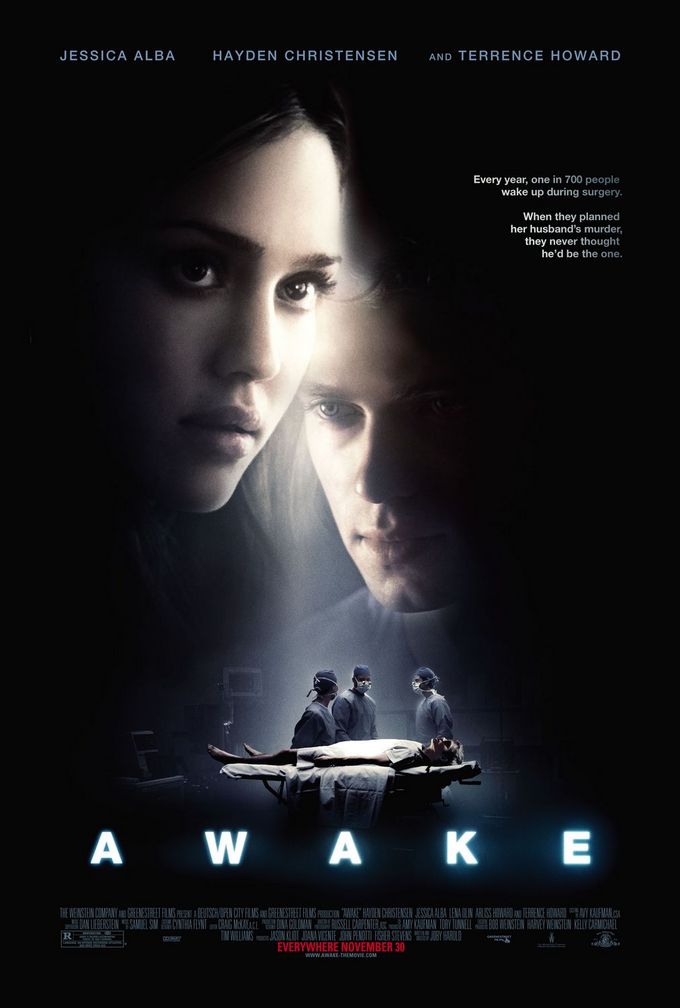
"Awake" (2007) - Movie Review

Sometimes when the writers/directors hit a juicy plot, they may run like Archimedes shouting “Eureka” (hopefully not naked). For most of the part “Awake” works perfectly. It is considerably a short movie, which could have been argued in both ways. The shorter version I believe is to move things quickly and when the second act occurs, the aim is to wrap it up soon so that to not make the viewers restless. It is done intelligently and follows in a fast step to step approach, almost. It is because the premise “Awake” sets up promised lot more things than a normal thriller.

We are given details about the concept of “Anesthesia Awareness” wherein a patient might very well be awake due to insufficient Anesthesia or other medical factors. The terror is this, due to the paralytic/muscle relaxants, the patient might not signal the people digging inside him to kindly inform this information. In mind he is awake and that forms the back ground. With a mild read in Wiki, it is said that it is a rare phenomenon and patients might recall pain and more than that, it is the freakiness of being awake in an operating table causes adverse psychological trauma. Clay (Hayden Christensen) spends most in his minds when his surroundings change in diabolique manner. The film does not have time for post traumatic stress disorder.

Clay is in the midst of confusion to tell his mom, Lilith (Lena Olin) that he is been seeing Sam (Jessica Alba) for a year and also is engaged. Added to that he is on the list for heart transplant. Sam is getting impatient by being not recognized and initially when Clay walks out of her car, we believe it is an affair he is conducting. Lilith is over protective and controlling of Clay. Clay is stressed out and he relaxes with his doctor who is more of friend after his first attack, Jack (Terrence Howard). Now every one are connected and that forms the main plot on the essence of the medical phenomenon as the leaping pad.

The first forty five minutes is where the hard work is evident. They managed to construct to form the situation to be poised in a stale mate during operation procedure. The initial couple of events to give a very small picture of the nature of Lilith, Sam and Clay appear out of place but necessary for character study. A film like this depends very little on profound behavioral science but the part I was mildly disappointed was the Clay’s mind experience. Tarsem Singh in his spectacular debut “The Cell” brought the mind world in shocking, explicit, disturbing and illusionary visuals. The freedom of using those is that imagination is boundless in that arena. What anyone thinks to see the pictures, hear the sounds or sense the touch/pain can vary vividly to its property which ultimately frees the director to work on it in without limits. And the same with Michael Gondry’s and Charlie Kauffman’s “Eternal Sunshine of the Spotless Mind” which can be compared to Clay’s journey in his mind. But in Kauffman’s it is profound and here it is to connect dots. May be I am complaining too much for a film like this which as it supposed to use those awe factor to pump up the thriller than indie style flick.

Yes there are some flaws and holes in the final moments of Lilith and Clay for the sake of “explanation” to the pay off. So they slightly nudge and bend some rules in the “awake” process and allow couple of transitions to complete the essay with proper defined full stop. The duration of the film can be contemplated. It would have been a great confrontation for Clay and could have been played viciously in a tit for tat fashion. A clever counter plot execution involving the key players would have been another nice ending. But they are happy with the set up and may be the extended version would have killed the momentum.

Debutant director Joby Harold has already been accused of inaccurately portraying the medical mishaps in the movie by the professionals. May be they are right or may be they are wrong but reading mind is still not in existence. Also, the inner journey is not the subject of matter. Like I said, it is a platform for a plot to fit nicely. “Awake” looses its grip in the end but at that phase, the film wants to end and hence audience will rarely look for it. I did but it’s me.

Wednesday, November 28, 2007

"In Good Company" (2004) - Movie Review

It is pleasure to be surprised. “In Good Company” which in poster and trailer addressed as a hopelessly romantic comedy with a formula whose second guess is an insult to explain it. As it says, a young rapid to the rise executive, Carter (Topher Grace) gets to replace Dan (Dennis Quaid) due to a company acquisition. Not only is that but Carter also is the new boss of Dan. And yes, he becomes the boy friend of Dan’s daughter Alex (Scarlett Johansson). Now that still looks like the romantic comedy I was talking about with “Sentiments for Dummies” written as a preface.

The co-director of the much witty, funny and dramatic “About a Boy”, Paul Weitz takes the leadership. Yes the above plot points happen in that series. But you see, this is not about the plot. It is a marketing strategy which appears to be from studio to promote the film. Essentially this is a character study of two men. One even though at the edge of this career, an old school ad salesman believes in what he does and the other who starts his career and already has tasted enormous success. This does not make him a smug, misdirected may be. It does put Dan in a position both financially and personally in dire situation with a baby on his way. He is bitter about knowing the fact how fast his life is changing and how old his daughters are getting. And he is getting old too.

Dan is the complete guy. He is happily married and has wonderful daughters. He is good in balancing his personal and professional life. You see it when Alex comes for tennis in his office on the day of re-organization; he is stressed but goes with her. When Carter ramps up ideas in their first conference meeting about combining with sister companies to promote the magazine, Dan asks whether it is not cheating. He is irritated but there is a truth in that. He sums it up in an end complimenting the belief he is been doing for 23 years. Both the personalities have personal and career challenge to tackle. Dan coping up with his daughter moving away while Carter with his divorce. The editing work by Myron I. Kerstein puts those changes side by side. There is not much difference happening out here but how each deal with it develops the story. Dan as the seasoned but yet pulling the weights more than he is supposed to keeps on going. Carter is filled with adrenaline and we come to know that he never really has been personal with any one. His life is fast paced and in the middle of it, forgets to see his life out of office go unnoticed.

Both are terrific salesman but Dan leaves his work at his office. The corporate culture created in the new world is dog eating dog strategy. Vocabulary of high phonetic word reeking positive energy is the trend. “Changing the world”, “Revolutionizing the human technology” or “Restructuring a better world”. Are these slogans for independence? Is this a rights movement? Nope, it is all for money. And Dan puts it straight on to shatter the spell cast on every one, mostly Carter. “Love your job, not your company” are the words said by CEO of Infosys, Mr. Narayan Moorthy.

This is the significance of the film. It never moves in haste nor is in the hunt for melodramatic twists to end sweetly. The other persons in these two people’s life are the key to fully see this whole chain of events in between them. Things we know are left unsaid. Director gauges his audience as intelligent personal and concentrates on points which a routine film might miss. The third act hinted on the oncoming “hence the theorem is proved” ending. It had the events which were perfect as rest of the movie but in reality they would have been scenes of burying the film in other motion pictures. The film finishes staying honest to it.

The small roles in particular scenes help the movie to come out from the mould. When Alex and Carter (un)expectedly meet before the end, there is another character Morty (David Paymer) who Carter enquires before seeing Alex. Morty does not know about the relationship of these two and learns as they talk. Now see there is this awkwardness being created in between these three. He immediately intervenes with a dialogue which not only breaks that but we get to know a little about Morty too. That is how the script is inured up to precision.

Topher Grace to the surprise sheds out his Eric from “That 70s Show” sitcom comfortably. He brings in the boyish charm he had over for Eric but loyally gives Carter, a reputed sales executive and a successful energetic young man. His body language is professional but his emotional incapability of Carter is what the film ponders upon. On the other hand, Dennis Quaid is such a fit for a happy family man. Part of the reason in “Frequency” that we really want nothing to happen to his family is the stature, boldness and fragility Quaid brings upon. Now here is another of the same kind but Dan Foreman is different from Frank Sullivan. We know why Dennis Quaid is cast but he makes Paul Weitz realize why he is the perfect man for the job.

Sometimes it is hurtful when films like this are missed due to its advertisements. I miss those because of my judgments but the trailer is designed such a way to lure audience. I am sure it worked and may be lot of people would have been disappointed too. It is interesting to know that the film which puts current marketing in question of its moral, the trailer shows that. Universal Pictures is a company too.

Tuesday, November 27, 2007

"The Good Shepherd" (2006) - Movie Review

“The Good Shepherd” is a victim and at the same time artistic saviour of its style. To tell a real story about a man whose life is nothing but secret is an irony. You need to portray it to factual detail of the emotional stabilization and unmoving soul of Edward Wilson and at the same time try to explain the genesis of CIA. Adding to that to bring out the difficulties, confusion and the regret of the character of his actions makes it a dead lock situations. Hence at the end of the film, we believe to have witnessed everything but so shallow and an in depth investigation on the surface to call it the origin, development and an untold story about the birth of CIA seems far fetched.

The movie moves back and forth in the 1961 after the Bay of Pigs invasion was lost in one of the US funded inside attack to overthrow Castro from Cuba and the flash back. It looks through following Edward Wilson (Matt Damon), a CIA officer. Then Edward is taken back when he is right out of Yale University which essentially starts the journey from 1939. He is getting recruited by a secret society called Skull and Bones which is a buffer tunnel to secretive operation of the country.

The tint of the film for most part in both the flash back and the current sequence has darkish layer. Shadows are used over the face of Edward to represent his half exposed and half hidden agendas. Then it shifts to confuse that nothing is as it looks. Everybody talks in cryptic language and deciphering it is waste of time for audience. I can see what director Robert De Niro is trying to do. He wants us to experience, I mean the true experience of following a spy who cannot even with himself be open and honest which would compromise sensitive information. Now this brings us to the term of information. The myth which as one of the character later tells being created to actually provide job security for the CIA. Comical but pragmatically makes a lot of sense.

The film is a patient process in building up the bricks one by one in a neat and clean manner. But this is the funny part, we see lot of images and left with nothing explanatory. The film laboriously takes 167 minutes to rest its case and we feel exhausted but an empty floor at the top. De Niro in the process of giving a character who spent all his life guarding the truth, lies and deception fails in the screen to bring it forward. Artistically it can be nothing more than spectacular to be brave enough to audaciously display this man full of hidden information. But the goal out here in this movie is to address the historic and biographic nature of an organization. Hence it needs to be laid out in detail on what exactly is happening out here. This conflict of interest ends the film with the same on what to conclude.

It is a well crafted professional movie. Matt Damon on an honest note needs to keep a straight face almost the entire time of the movie. He is in every frame and that makes him important. May be we get used, bored and unnoticed by seeing him emotionless for such a long time that he disappears as a character. He does not love his wife, Margaret Clover (Angleina Jolie) but loves his son, Edward Jr. (Eddie Redmayne) due to which he married Clover. His real love got lost with Laura (Tammy Blanchard) but he never gets time or his nature of job does not allow him to get closer to his son. While it is acceptable to have an older son when Edward is not much of an old age, Matt Damon does not look mature enough to make us believe to be the father. And being Angelina Jolie just made him even younger. Nothing wrong with acting but looks like Damon is not the right cast for the role. But he suits perfectly for initial upbringings. When he looks inexperienced yet has a professional outlook is remarkable. Particularly circled by experienced actors like John Turturo (Watch out for the scene when he joins duty under Matt Damon, spectacular!), William Hurt and Robert De Niro, the Matt Damon character from real life as such suited the young Edward Wilson. The cast is out of norm when the scenes of him being around the age of forty pops up.

Overall I liked the movie. The thing is the confused identity of being in a specific list it tries to be. The battle becomes the perplexing content and hence loses itself. It is dangerous to think about the cold war game of two individuals eventually affecting two nation’s fate. Even when the leaders of the two countries discuss their relationship either in amicable nature or animosity, the ground level players are the coin movers. There are four characters to be compared and analyzed for this spy game. We meet Dr. Fredericks (Michael Gambon), a man without any emotional ties, who has seen all and being a mentor tries to warn Edward before his demise of a sweet exit right away. Edward in a state of effacing his father’s disgrace and approval drives him beyond the warning of Dr. Fredericks. The other is the British Intelligence official, Arch Cummings (Bill Crudup) who we get to know a little is aware of his actions but he too appear to be without family. Ulysses the adversary of Edward in the Soviet front knows more about everything and estimates Edward better than Edward does on Ulysses. This does not mean Edward is not a good player; it is just that the weakness for Edward is more than the Ulysses’ weakness of not like being in a cold weather. Edward who seems devoid of emotion and attachment indeed has the weakness and also his strength which is his last touch to reality, his son.

Monday, November 26, 2007

"Bottle Rocket" (1996) - Movie Review

The front running characters in “Bottle Rocket” are so aimless, stupid, crazy and irresponsible that we ourselves take a vacation from us in getting in an adventure these guys aim, especially Dignan (Owen C. Wilson). After seeing “Rushmore”, “The Royal Tennenbaums” and the impressive “The Darjeeling Limited” of Wes Anderson and his partner Owen C. Wilson, I wanted to see where it all started. And it is interesting to investigate on how it developed. How these two along with Luke Wilson formed a fraternity for themselves in a novel deadpan serious comedy and drama of invention into the screens of Hollywood.

There are no deep analysis of the back ground of Dignan and Anthony Adams (Luke Wilson). We just know that they are friends and Anthony checks himself out from “nut house” as they describe it. Dignan does not understand that Anthony is checking himself out and enthusiastically waits at the gates for his friend to do the escape. He is like a kid inspired by chase/action/heist movies and instead of playing with his fellow friends (which actually would have been even weirder), he plans and believes to do it meticulously in some uncommon places (like a bookstore). He lays out seventy five year plan for him and Anthony. Then they burgle a house which we later realize is Anthony’s family house. Dignan recruits Bob (Robert Musgrave). So you can think how Bob is. But we get a slight back ground of who is, in terms of family and house. He is a rich kid bullied big time by his brother John (Andrew Wilson). He is jobless which goes without saying. While he wants to jump in the adventure Dignan promises, he is also caught up by the sense of real life.

Anthony explains to one character that one fine day he decided to not see any of the people again and hence checked voluntarily in to mental hospital. He says he was exhausted to his sister Grace (Shea Fowler). She says that he never worked in his whole life. Quite right. Anthony is caught up with the ring of Dignan’s fantasy plans and also manages to blindly fall in love with the pleasant and friendly house keeper of the motel they stay, Inez (Lumi Cavazos). The film can be as bland as it can be and yet there is something going on the screen especially with the blind confidence of Dignan showed by Owen. He is so mixed up and his dedication is insane that we have a slight fear of this character’s next step. They play with guns and still we know they are harmless.

The film does not offer any concrete plot but I know what to expect of Anderson’s movie. He develops the world as I have defined in “The Darjeeling Limited” and plays it around and within that. It was surprising to see couple of police cars which looked out of place in the movie. That is the extremity of strange universe Anderson creates. There is nothing to plot upon or discuss on the dead pan emotions of almost every character.

But in a way I was glad it was aimless and stupid. There might be an empathy for these characters who quite honestly does not know where they are headed. Dignan despite being the formulating leader of the 75 year plan for them is the clueless person of all. Anthony actually seems to be sane but in reality he is in battle with the reality and commitment towards his friendship with Dignan. Otherwise you do not see some one getting out of mental asylum sought an adventure game devised by his friend.

Anderson’s slow motion is scarcely used as it is the first movie while the songs say their selection of thematic elements to the film. The film did not fare well in the box office which is of no surprise. It is a clear cut independent movie and quite evident that couple of talented artists trying to find their right frequency.

“Bottle Rocket” does its job for the first timers Anderson and the Wilson brothers. It is bland, flat and it turns out the final parody/homage of heist scene into a hysterical eruption of laughter. And when the out of place Kumar (Kumar Pallan) says “I blew it man”, that is the high point of comedy. That is where the film takes it tuning on. In a way we do not expect them to perform the big heist, as we might know the result. Even after we know that they are going to screw up, the way they screw up is orchestrated with randomness. It is a thrilling and entertaining moments of failure beating itself in stupidity and idiocy.

Saturday, November 24, 2007

"The Mist" (2007) - Movie Review

Good news of “The Mist” is that there are no zombies. But yes, there are creatures mainly aiming at human flesh for apparent reason of quenching their hunger I guess. This might be the only unexplained thing the film might have. Rest of it makes this one terrific thriller in the horror genre. As regular readers of this blog might know the dislike I have for horror genre due to the reason of unnecessary gruesome and gore. “1408” encouraged me to go for the film and mainly the team of the great movie, “The Shawshank Redemption” come together once again, Director Frank Darabont and famous writer Stephen King; it is two good reasons to watch “The Mist”. Sure it is not the category of “The Shawshank Redemption” but it resembles the human emotions, mentality and their act of unexpectedness when put in a situation threatening their life consisting of beliefs.

An artist David Drayton (Thomas Jane) in a remote village decides to take his son Billy (Nathan Gamble) and a bitter neighbour Brent (Andre Braugher) to the super market after a storm hit them the day before. A mist soon covers and Dan (Jeffrey DeMunn) comes screaming into super market and says the person along with him was grabbed on by something ferocious. No one understands the phenomenon including us but we know it is the setting for the mysterious creatures to attack. Soon it happens and the first thing is that some people do not believe about the existence of the creatures as David says who personally witnesses one along with Ollie (Toby Jones) one of the store employee, Jim (William Sadler) and Myron (David Jensen). Basically more than creatures it slowly turns out to be people taking sides. The things falls apart when a over religious lady Mrs. Carmody (Marcia Ray Garden) whose non-stop ramblings attracts the people who are in a situation to believe in anything to be saved upon, even if it is the ridiculous preaching of Mrs. Carmody.

It is a film about human horror. The decisions and the resultants of those decisions cannot be weighed. It is a closed environment with the fear of death. It is the kind of death which scares every one. While the hopes of getting out appear bleak, things start to boil with the egos and stupidity swinging by in front of David. And David automatically sanctions to be a leader in to the group of people who think the same or rather think that David makes lot of sense gives his son to a new resident of the town, Amanda (Laurie Holden). The mob mentality is dealt with such a precision of human behaviour that many people might not notice how well it happens in a world of no creatures, pressure or insanity. This is pure manipulation of making others to follow the thing the only person thinks is right and even if it means of killing some one. In the name of god, anything can be done. It is easy to blame and act on some one who might not come into your face and even if that happens, the firm believer of that will not believe. That is the weirdness of the religion and the principles. It gives what you want on how you see it. Goodness or evil is in the definition of one’s own perspective and not in the religion or god.

What Stephen King and Frank Darabont give is an extra ordinary psychoanalysis of humans. The decision, the conflicting values and thoughts, the stubborn nature of even forgetting the grave circumstance of existence and mainly hope. The film gives creepy sense of feeling because of its hopelessness. Along the journey, we ourselves have restrained into going out. That’s not a choice but the people inside are even more dangerous than the creatures outside. It is certain death and it becomes a choice of how and when. But still people fight. Our fight of survival is unbelievable even when the future is a certain dark. And yes, some people decide to give up. I am talking about the majority of the people who gets bored of waiting and curiosity does the unthinkable even if it’s certainty of bringing doom.

What David or any one does in the film can be analyzed but the rightness and wrongful nature of it cannot be easily dissected to get a meaning or lesson out of it. There are lessons but some one who has been put through such a kind of treatment to extract sense out of it is tough. The end is a disturbing one. Quite fantastically it adheres to the nature of the film but after all my lines about judgments of right and wrong in a situation, this seems implausible for a character so strong and hopeful to behave in that manner.

In the process of watching the film, we shed the fear of death as certain character does by the encounters. I realized after couple of scary scenes that this is not the main plot. It is a background and the main horror is within the super market. Marcia Ray Garden performs Mrs. Carmody with the belief of the character over god and religion as with the person itself. She spits venom and pushes every wrong buttons in the audience. Her character is the one which questions the system of our society as such.

My judgments over horror genre got shattered. I am lining up my queue with some good ones of these kinds. This film is a roller coaster ride of thriller but an emotional analysis of who we really are. How we would behave in a pressurized closed situation threatening our existence? Is a belief a sin or a gift? Does values and principles aid or mislead us? Every one will get different answer and that’s exactly we all are. Conflicting individuals desperately trying to make ours the superior one. Some might not try and some might give their life. Earth is a big super market in “The Mist”. We are all there and we are doing the unthinkable.

"Enchanted" (2007) - Movie Review

I wrote in my review of “August Rush” that it is a cheesy hallmark card. And I say it once again for “Enchanted”; the difference being I gladly accepted and enjoyed it in the process. It is no wonder when Robert (Patrick Dempsey) tells Giselle (Amy Adams) that she talks like some one jumping out of a Hallmark card. Well she is from the fairy tale fantasy world which we believe to reside only in books and films. The film happily takes us in its merry celebration due to the belief the actors/actresses put in. That makes this one sweet film for wide audiences.

Giselle living in her happy cartoon/fairy tale world meets her prince charming, Prince Edward (James Marsden) and loyal to their surroundings, get ready to marry after one day or may be one kiss which they define “True Love Kiss”. It cannot get cheesier than this. But wait, the plot gets interesting with known predictability of this “true love” would pour water in the idea of the evil queen and step mother of Prince Edward, Queen Narissa (Susan Sarandon). Hence she curses upon Giselle and pushes her to a well which directly connects into middle of scary New York City. There she manages to stumble upon Robert, a lawyer and a single father trying hard to look in through the actual love. He gifts his kid daughter Morgan (Rachel Covey) a book about famous people. He does not want to raise her giving fairy tale hopes since his life has been unpleasant pot holes.

Giselle played with much sincerity by Amy Adams who we know gave the bubbling energetic Ashley in “Junebug’ recreates some one of the same energy but with a twist of fantasy character. I am sure she would have got pain in her mouth due to the time and wideness she smiles about, almost all the time in the movie. But it is not annoying rather inviting and refreshing. Apart from her, whoever comes from the world of fantasy believes in their character so much that some times they would have felt awkward playing one in the reality in front of a camera to uplift further fakeness of it. But we want to believe as we did as kids on these wonderful characters who have a charm even in the wicked characters, the animals who abides happily to their kind orders of princess.

I have thought about the concept of Indian Cinema’s songs taken properly into the Hollywood would bring in a genre of its own. Director Kevin Lima manages to squeeze in couple of songs which moods in the perfectly situational circumstances and very well lovable as any rhymes we have memorized out of likeability than a duty. Accompanying visuals oozes its energy and emotions to tag along the song as necessary.

The main tactics is the use of the fairy tales as a bow of self parody and homage at the same time. I noticed number of it and realized through Wiki that there are so many more than I picked out. Those references does not come as an unnecessary addition but plot points, humour and fun as any fantasy film would like to have. Apart from Amy Adams, James Marsden and Patrick Dempsey has the art of getting to the level of their character to a seasoned and perfected tone. It is not catchy enough to notice them but interesting at very crucial points to the character of Giselle. Without them the story would have been a mere “Alice in New York City” with nothing but boring adventures.

It is curious and entertaining to watch a character from the happy faced ambience learns to identify its true love and the dull faced earthly character finding it’s through this encounter of a young woman who radiates tireless consistent energy. It was slightly disturbing to see cockroaches dancing and cleaning (yeah, cleaning!!) a house in a uniformed sequence. Many got more than slightly disturbed of the hanging ceilings of insane colonies of rats in “Ratatouille”. If they think so, see this and they will faint. It was not particularly a cherishing moment but tell you what, it is highly unlikely for that vision to witness without worrying about our kitchen being conquered by those fiery little creatures.

“Enchanted” targets all the audience and it has something to offer for every one. If some one seriously is going to resist smiling or denies not having fun with a straight face quoting being that the movie is not for mature audience in their condescending tone, then they are not “mature” enough to truly appreciate the beauty and charm the film has to offer. I loved the Hall Mark cheesy card as a film and I sincerely acknowledge it. (Alright. Now is the time for a representative of Hall Mark to send me a cheque for my publicity of them)

Friday, November 23, 2007

"Hitman" (2007) - Movie Review

When action block busters are made, they are made within the confined world the film maker designs. The director needs to find the skill to make that world to engulf the viewers too, so that the ordinary logical laws surrounding the real one gets erased, for the time of the movie. The video game inspired “Hitman” manages to find that and survives till the end. With Timothy Elephant as Agent 47 who gives a cool take on this solid killer who does not quite seem to be the killing breed of “Soldier” and the active clever one of The Bourne Series. He is not Ethan hunt and he is not that skillful either. Yet, something intriguing about him finds us in the midst of going through the film.

It might be stupid to discuss the plot. Mainly that it does not need much of it and secondly, I did not really care or even understand some of it. But it does not really matter for a movie that makes bald men with bar code tattoo on their back wandering in the streets with the guns, knives, bug devices, poison and god knows everything which needs to put a person to rest, temporarily and permanently.

Yes, we know the Agent 47 will be set up. He needs to run for his life. And along with a seductive vixen, Nika (Olga Kurylenko) but a soft natured woman inside who has dreams of having vineyards and how our killing machine grasps it to have an end, every one knows except her. But the Nika is not irritable as most character in that skin will be. Apart from her sensual appearance, the character seems to understand the nature of the killer and brushes the limits as necessary. Hence we do not mind her and also some times like her too.

As for the good cop for a film of this kind, Mike Whittier (Dougray Scott) does the same what Nika does. Even though no one believes him as he does on this invisible existence of the killer, he manages to run the plot as fast as he can. And surprisingly his subordinate Jenkins (Michael Offei) is not just there but does something. Hence every character does its part to keep the story moving and not allowing the viewers to think much. Allowing them to think is the suicidal risk, the movie of this nature cannot afford to.

The music keeps the flow coming while being dedicated to the gaming environment too. There is certain camera angles purposely framed to be homage and to give a feeling of the game. Similarly having the kids Agent 47 breaks in while he escapes playing the “Hitman” game itself is quite charming. The concept of bringing the game to the screen takes me back to my gaming days. Hence I decided to share during this opportunity of a movie based on a game.

I remember playing the game “Prince of Persia: Sands of time” during graduate school. Having seen the original first time graphic “Prince of Persia” when PCs got their way into the regular lives, the advanced graphic natured form invited to play irresistibly. I and another friend of mine took turns and completed the whole big game. The game as such a huge one and the numerous tries we took extended it for more than two months in the middle of mid terms and home works. The story line was incredible and the ending blew us. I never realized a game can be as plot intriguing as this. After that I never really played. I eyed over “Prince of Persia: Warrior Within” but never took off. It is amazing to see games getting its form adding to the regular short stories and novels. Gaming is one of the biggest industries and rarely do people believe in the extraction of intellectual value out of it. But I do not think so as there are umpteen different genres in it and it somehow or other reaches the audience who are just as passionate about any other thing. I know comic book fans are one such and their passion is taking its screen time too. It is quite interesting to see how different forms of art in the modern world technology not only provides story line but altering, changing and inventing new form of film making. It is definitely healthy. May be “Hitman” or “Tomb Raider” is not the ultimate definition of movie making but it took lot of time to get a experiencing “300” and acclaimed by many of its predecessor in this kind, “Sin City”. It is just a matter of time when strategic and emotional gaming might take its form. May be the much addictive “Age of Empires” or the “World of Warcraft” would come alive in the big white flag of cinema.

"August Rush" (2007) - Movie Review

“August Rush” is a hallmark cheesy card. We acknowledge when some one gives on the nature of the gesture rather than the card itself. I was not able acknowledge because I was in the paying end and I deserve better for my 7$. I remember seeing “I am David” and how much I was trying to like it and its fiasco of letting me down till the last screen shot of it. “August Rush” starts with a very promising note of how the two people Lyla (Keri Russell) and Louis (Jonathan Rhys Meyers) blend in their music by kind of telepathic feeling through their music. Then it carries on with people staring at the skies, closing up the kid’s eyes and some very badly written clichéd dialogues to make this sporadic musical film into a very ordinary and a boring one in the end.

Evin (Freddie Highmore) believes he can hear music in anything and everything around him. When he composes the grasses over the corn field and it dances around his waving of small hands depicts on what he believes. His voice over tells what he feels and how he connects with his long last parents whom he had never seen or seem to know. In their one night discovery of true love (duh!), Lyla a classical Cellist and Louis a rock band singer gets separated by a stubborn father of Lyla (a big duh!). It would have been 1995 but cell phone, internet seem to be non-existent and Louis never tries to meet the “love of his life” until after 11 years and some months and some days, sorry “I did not count”.

The lameness starts out there and beats us cutting every shot to these three characters that desperately need to look into the “lost & found” section in the three cities they jump around, New York, Chicago and San Francisco. Fresh are some of the scenes and some are enjoyable too. I vehemently oppose using a sweet kid’s face as an emotional spectacle and leveraging the though of cinematic punch points. I wishfully want a non-sweet kid and more of terrific acting. Freddie Highmore does the job director Kirsten Sheridan has wanted to, be sympathetic, pale and smile as the cherubic kid every one wants to look at. But Sheridan uses that as the only corner stone even more than the music at times which they movie preaches.

I give in to the belief of people having that extra telepathic perception. In recent days, I have started to vaguely understand the nature of unexplainable force and bond connecting every one in the world. Quite cheesy but appears to have some feeble sense in reality. The power of consoling, comforting and even completely blowing away the art of manipulating has something more to do than the way some one looks, talk or acts. Having try to be in the Zen zone, there is only very little effort to convince some one like me and if they can fail in that, then I would say that the film lacks a lot as a natural musical representation.

Composer Marc Mancina seems to have been working on the score for the past one and half years. It is that which makes the routine scenes liven up to the fanciness it boasts. The songs faded away though. The first one was the best which I can very well be in my iTunes buying list of songs. And the dialogues, some thing like this, “What are you looking at?” and the reply of “You”. “You look crazy” and the reply of “I am Crazy” makes you think that the director read “Good dialogues beaten to death” by “Always thinking it will work directors”.

Music on the screen is a tricky subject and having seen this movie and couple of others, I can appreciate how much the movies in my native language have those challenges in front of them. When you see the trailer and poster of “August Rush” and the kid’s face, you go in with the full notion of liking the film. You know the steps and just sit back and enjoy it. When some one during that process laughs at my spending of ticket money and call me a loser, you know what, that hurts. More than the kid’s pain in the film of not finding his parents.

Thursday, November 22, 2007

"No Country for Old Men" (2007) - Movie Review

When I watched Coen brothers’ “Miller’s Crossing” and the greatly acclaimed “Fargo”, both had the similar reaction in me. It did not bore me but it did not strike me either. The trend of their film making and its impact on me continues through “No Country for Old Men”, an adaptation of the novel of same name by Cormac McCarthy. This film actually has some better moments which I enjoyed more than the other two though. Still bland, just to be clear enough.

Anton Chigurh (Javier Bardem) is a terror. If he is on the screen, then it is the fear of his merciless execution. If he is not on the screen, then it is the fear of him coming and continues his blood spree. The Coen brothers use this fear to make us be in constant awareness and to be attentive. We do not want to see it, but yet you cannot help it. And Javier Bardem cannot be scarier and cold than this performance. I would very well classify the movie to be a horror, with psychopathic creature of strange principles. It is symbolic to represent him in black dress because that is the only mourning he does to the numerous killings. He is not a person who is after for money. Because one would wonder his spending choices will be, mainly there is no evidence of enjoying anything at all. Even the killings, being a psychopath, works hurrying but systematically, yet does not look like a passion. For some reason, he is after the money and I would guess his “principles”. Quite a follower.

Then comes the matched opposite to tackle him, or may be lucky too. That is Llewyn Moss (Josh Brolin) who on regular hunting day finds bodies, drugs and of course, a lot of money. He has a flexible conscience as any average human being tend to have. He goes back to the spot for offering a chance of life for a man he deserted during his first visit. Too late and too wrong to be in that place. He is a man perfectly acting and knowing his consequences. He knows wrong and does it. He is smart, calculative but just that the risk factors he calculated does not load his future in the correct direction. He runs and looks back. Chigurh is coming. That sets his life till the end.

The other interesting and often mysterious character even though he is the one who has good amount of dialogues is Sheriff Tom Bell (Tommy Lee Jones). He is at the end of his career. He wants to help the local guy Moss and promises the safeguard to his wife Carla Jean (Kelly Macdonald). He has had it with the violence and to be a witness to the conscienceless acts of very many in his daily life starting from the days of his war. He believes this is his last case to solve and rightly leave to call it even with his sins.

Now these three characters are much well supported by many good casts. Which technically makes every scene of some interest or other. Now the part I had no interest are the final takes along with Bell. The accent swallowed some meaning and the rest meant something, but the blunt end leaves you with a vagueness of incompletion. It is not customary for any film for a period end and I am the sort of person who enjoys those kinds of endings which leaves a sense of continuing imagination. The lurching end out here opened the gates of void.

There is a style for the Coen brothers’ films. The dryness is what I would call it. We have seen dry comedy but the drama of that flavour is special. Making it interesting enough with that property is even more challenging. Their films have a plot of total insignificance. Any other movie maker would have opted on concentrating the racy nature and may be even make it the summer blockbuster. These guys completely go into the opposite direction of taking the elemental characters and give them something which does not shine but mildly glows. So when there are collective efforts from every one, we get their film. Sadly, this category while entertains me does not strike me as a master piece.